Domains & Micro Focus Groups

Members can network thematically in the five domains or exchange ideas more specifically within the numerous micro focus groups.

DOMAINS

DOM: Physical Sciences

The Domain Group integrates interdisciplinary research across physics, chemistry, and related physical sciences to investigate how Artificial Intelligence contributes to discovery and innovation in the field. By accelerating progress in modeling, simulation, materials research, and experimental analysis, the group helps unlock new insights and push the boundaries of scientific understanding.

DOM: Manufactoring / Industry

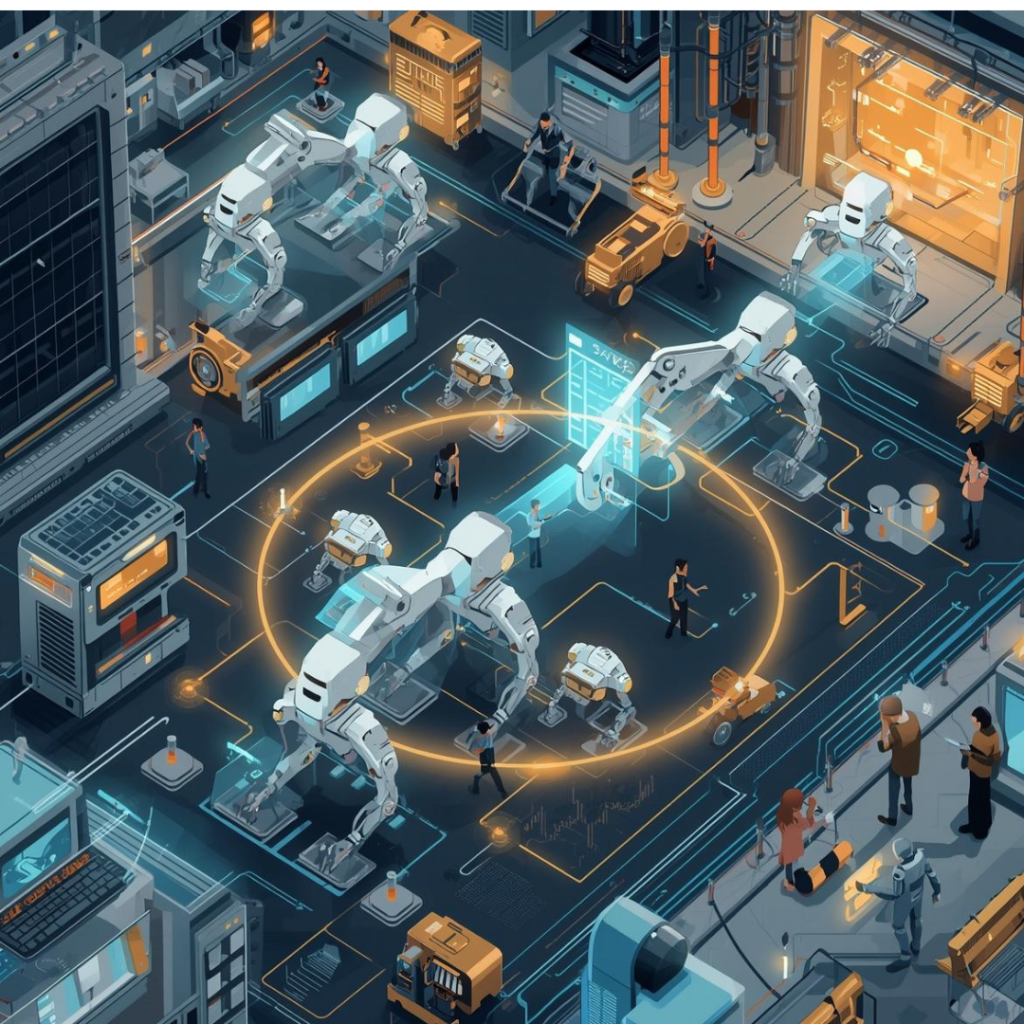
The Domain Group connects diverse research efforts across manufacturing processes, industrial systems, production technologies, and automation. Its focus lies in examining how Artificial Intelligence is reshaping industrial landscapes—enabling intelligent factories, optimizing predictive maintenance, enhancing quality assurance, and fostering seamless collaboration between humans and machines to advance the next generation of smart production.

DOM:
Mobility

The Domain Group brings together interdisciplinary research on drones, cars, trains, and planes, covering the entire spectrum of mobility and transportation systems. It explores how Artificial Intelligence is transforming the mobility sector—through automation, enhanced safety, sustainable solutions, and intelligent infrastructure—while fostering dialogue on the future of connected and adaptive transportation.

DOM:
Life Sciences

The Domain Group brings together interdisciplinary research from medicine, biology, and related life sciences to unlock the potential of artificial intelligence for understanding living systems. The focus lies on applications in diagnostics, drug development, personalized medicine, and fundamental biological research.

DOM: Humanities, Behavioral and Social Sciences

The Domain Group brings together interdisciplinary research from economics, sociology, philosophy, law, and political science to investigate the complex interactions between artificial intelligence and society. At the center is the interface between technology and social structures, where questions of human behavior, ethical responsibility, and political governance are addressed and constructive dialogue is fostered.

MICRO FOCUS GROUPS

Here you will find our current micro focus groups

This group focuses on real-world applications of machine learning, exploring how models can be designed, deployed, and evaluated to solve practical challenges in health, finance, mobility, sustainability, and beyond.

ML: Applications

This group explores real-world applications of computer vision, focusing on how AI can extract and use visual information to solve practical problems in healthcare, mobility, industry, and environmental monitoring.

CV: Applications

Diese Gruppe beschäftigt sich mit dem praktischen Einsatz von Robotik in realen Umgebungen, wobei KI mit robotischen Systemen kombiniert wird, um anspruchsvolle Aufgaben in Industrie, Dienstleistung und Alltag zu lösen. Im Mittelpunkt stehen sowohl die Umsetzung robotischer Technologien als auch die Bewertung ihrer gesellschaftlichen und operativen Auswirkungen.

ROB: Applications

This category explores models and systems that emulate human-like cognition by integrating perception, reasoning, learning, memory, and decision-making. Research includes symbolic, connectionist, hybrid, and embodied approaches to building autonomous agents that adapt over time and act in goal-directed, context-aware ways. The aim is to design cognitive architectures that reflect core aspects of human or animal intelligence.

CMS: Agent & Cognitive Architectures

This category focuses on machine learning methods with built-in privacy protections to safeguard sensitive data during training, inference, and deployment. It includes approaches such as differential privacy, secure multi-party computation, homomorphic encryption, and privacy-preserving federated learning. Research addresses the trade-off between model performance and data confidentiality.

ML: Privacy-Aware ML

ese Kategorie befasst sich mit maschinellem Lernen in dezentralen oder verteilten Umgebungen, in denen Daten und Rechenressourcen über mehrere Geräte oder Organisationen verteilt sind. Im Fokus stehen Verfahren für gemeinsames Modelltraining ohne zentrale Datenteilung sowie Herausforderungen wie Kommunikationseffizienz, Datenschutz, Heterogenität und Systemrobustheit.

ML: Distributed Machine Learning & Federated Learning

This category focuses on computational models of brain function and structure, using simulation, mathematical modeling, and machine learning to study neural mechanisms. Topics include neural coding, cognitive architectures, brain-inspired computing, and large-scale brain network simulations. The research bridges neuroscience, AI, and cognitive science, spanning both biologically detailed and abstract models.

CMS: Brain Modeling

Human-in-the-loop Machine Learning

HAI: Human-in-the-loop Machine Learning

Diese Kategorie befasst sich mit der Interpretierbarkeit und Transparenz von NLP-Modellen. Sie umfasst Methoden zur Analyse der Sprachverarbeitung, Erklärung von Modellentscheidungen, Aufdeckung von Verzerrungen und Verhaltensanalysen über verschiedene Aufgaben und Sprachen hinweg. Ziel ist es, NLP-Systeme verständlicher, vertrauenswürdiger und besser überprüfbar zu machen.

SNLP: Interpretability & Analysis of NLP Models

This category explores how AI systems can integrate moral reasoning, ethical principles, and human values. Research includes modeling and learning moral norms, addressing ethical dilemmas, and enabling value-sensitive decision-making. Approaches range from computational frameworks to interdisciplinary methods involving philosophy, law, and the social sciences. Example topics include fairness-aware reinforcement learning, logic-based modeling of moral dilemmas, and culturally sensitive value alignment for AI assistants.

PEAI: Morality & Value-based AI

This category focuses on algorithms that enable AI systems to anticipate, interpret, and adapt to human behavior in dynamic settings. It includes methods for predicting intentions, goals, and actions, and for planning with human preferences, beliefs, and uncertainty in mind. Applications span human-robot interaction, collaborative systems, autonomous vehicles, and assistive technologies. Examples include pedestrian trajectory prediction, adaptive robot motion planning, and driver intent modeling in mixed-autonomy traffic.

HAI: Human-Aware Planning and Behavior Prediction

This category covers computational models and algorithms for interpreting brain activity and cognitive states using brain-sensing technologies such as EEG, fMRI, MEG, and NIRS. Applications include brain-computer interfaces, neuroadaptive systems, and cognitive state modeling. Contributions span signal processing, machine learning, human-AI interaction, and hybrid neuro-symbolic methods. Examples include mental workload classification from EEG, decision prediction from fMRI, and real-time BCI systems using graph neural networks.

HAI: Brain-Sensing and Analysis

This category covers supervised learning methods for predicting classes or continuous values from labeled data. Techniques include neural networks, decision trees, support vector machines, and ensemble models, with a focus on building models that generalize well. Applications range from cancer subtype prediction and drug response estimation to cell type classification in single-cell RNA-seq data.

ML: Classification & Regression

This category focuses on unsupervised learning methods for uncovering structure in unlabeled datasets by grouping similar data points. Techniques such as k-means, hierarchical clustering, density-based models, and deep clustering frameworks are used to explore data, generate hypotheses, and enable tasks like patient stratification. Example applications include identifying novel disease subtypes from multi-omics data with spectral clustering, discovering gene modules with shared expression across tissues, and grouping patients based on metabolomics profiles using deep embedded clustering.

ML: Clustering

This group explores how knowledge can be formally represented and logically processed in AI systems. It focuses on symbolic approaches that enable machines to reason over structured data and draw meaningful conclusions. Core research areas include formal languages such as Description Logics, OWL, and First-Order Logic; automated reasoning and inference; ontology design for domains like healthcare and manufacturing; hybrid neuro-symbolic methods; and applications in explainable AI and decision support.

KRR: Knowledge Representation and Reasoning

The NLP: Ethics — Bias, Fairness, Transparency & Privacy group examines the ethical and societal implications of Natural Language Processing technologies, focusing on how algorithmic decisions affect individuals and communities. It investigates methods to detect and reduce bias, enhance transparency, and protect user privacy in NLP systems. Key areas include fairness-aware training for large language models, interpretable content moderation, and privacy-preserving techniques in conversational AI.

SNLP: Ethics — Bias, Fairness, Transparency & Privacy

Affective Computing explores the interdisciplinary field of systems capable of recognizing, interpreting, and responding to human emotions. This research group unites experts working on computational models of emotion in AI, with applications spanning psychology, education, and human-computer interaction. Areas of focus include multimodal emotion recognition from text, speech, and facial expressions; emotion-adaptive learning environments; and emotionally aware agents for digital mental health support.

CMS: Affective Computing

Bio-inspired Learning explores computational models and algorithms inspired by biological systems, such as neural networks, evolution, and swarm intelligence. This approach aims to create efficient, adaptable, and intelligent systems by mimicking the problem-solving strategies of nature, advancing fields like AI, robotics, and optimization.

ML: Bio-inspired Learning

This groups tackles challenges in safety, infrastructure, and sustainability. From emergency detection in households to clean water prediction, electric grid optimization, and real-time health monitoring, they combine innovative computational methods with practical applications. Together, they aim to deliver impactful solutions for pressing societal and environmental needs.

ML: Probabilistic Methods

This group focuses on designing AI systems that learn to generate and reconstruct data, uncovering complex patterns and structures. These models are vital for advancements in data compression, anomaly detection, and creative AI applications, driving innovation in fields like image synthesis, language generation, and scientific simulations.

ML: Deep Generative Models & Autoencoders

This group explores the dynamics between humans and robots to design systems that are intuitive, safe, and effective. This research is crucial for advancing robotics in areas like healthcare, industry, and daily life, ensuring robots enhance human capabilities while fostering trust and collaboration.

ROB: Human-Robot Interaction

This group explores how to mitigate biases, ensure fairness, enhance transparency, and safeguard privacy in AI-driven language technologies. This work is vital to building ethical, trustworthy, and inclusive AI systems that positively impact society.

SNLP: Bias, Fairness, Transparency & Privacy

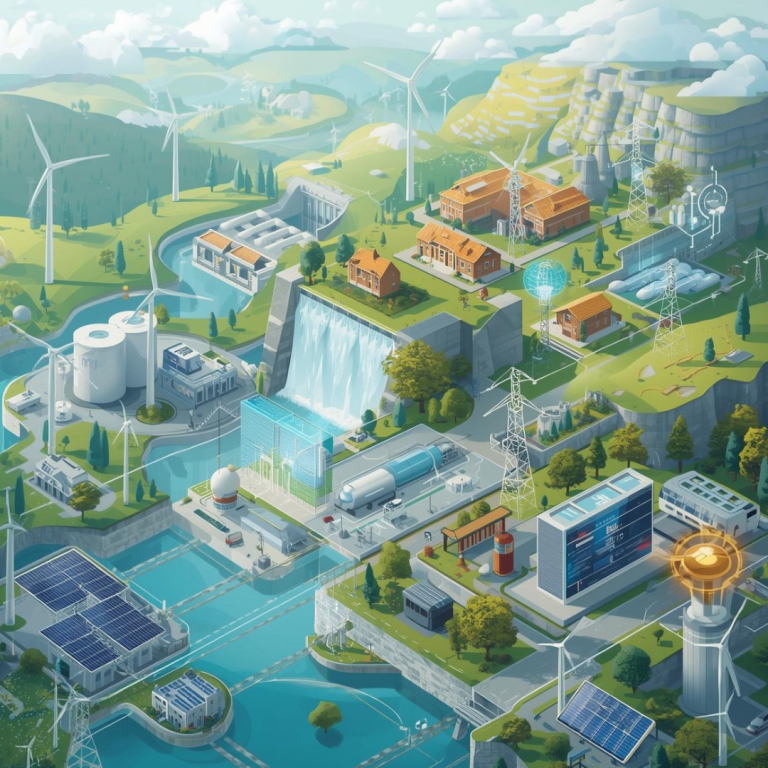
Climate change and its consequenes are one of the most pressing topics of todays society so it is only natural that AI algorithms should play a vital role in the efficient use of our energy.

Energy-efficient AI

Automated Machine Learning can save valuable time and energy when using ML algorithms. By continously adjusting hyperparameters, performance can significantly increase.

ML: Auto ML and Hyperparameter Tuning